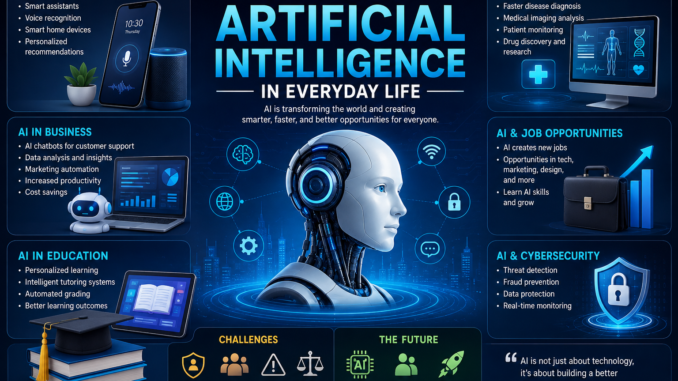
Artificial Intelligence (AI) is no longer a technology of the future. In 2026, AI has become a major part of daily life, helping people work faster, communicate better, and solve problems more efficiently. From smartphones and smart homes to healthcare and online businesses, AI technology is transforming the world at an incredible speed. Businesses, students, freelancers, and content creators are all using AI-powered tools to improve productivity and increase income opportunities.
What Is Artificial Intelligence?
Artificial Intelligence refers to computer systems that can perform tasks that normally require human intelligence. These tasks include learning, problem-solving, language understanding, image recognition, and decision-making. AI systems are trained using large amounts of data and advanced algorithms to improve their performance over time.
Popular AI technologies include:
Chatbots and virtual assistants
AI image generators
Voice recognition systems
Self-driving technology
AI writing tools
Recommendation systems on YouTube and Netflix
Today, AI is integrated into almost every digital platform people use daily.
AI in Smartphones and Smart Devices
Modern smartphones are powered by AI features that make devices smarter and more user-friendly. AI improves camera quality, battery optimization, voice commands, and security systems. Features like face unlock, voice assistants, and automatic photo enhancement all use AI technology.
Smart home devices are also becoming more popular. AI-powered systems can control lights, air conditioning, security cameras, and even household appliances automatically. Devices such as smart speakers can answer questions, play music, and control home systems using simple voice commands.
As AI hardware becomes cheaper, more households around the world are adopting smart technology.
AI and Online Business Growth
One of the biggest advantages of AI is its impact on online businesses. Companies use AI to analyze customer behavior, improve marketing strategies, and provide better customer service. AI chatbots can answer customer questions 24/7 without human support.
Digital marketers use AI tools to:
Create content faster
Generate social media posts
Analyze website traffic
Improve search engine optimization (SEO)
Run targeted advertising campaigns
For small business owners, AI reduces costs and increases efficiency. Freelancers and bloggers also use AI writing assistants to create articles, scripts, and business ideas quickly.
Because of these benefits, AI-related businesses are among the fastest-growing industries in 2026.
The Role of AI in Education
Education technology has changed significantly due to AI. Students can now access personalized learning experiences through AI-powered apps and platforms. Online learning systems analyze student performance and provide customized lessons based on individual strengths and weaknesses.
AI helps teachers by automating grading systems and managing classroom activities. Language-learning applications use AI voice recognition to improve pronunciation and speaking skills.
Some major benefits of AI in education include:
Faster access to learning materials
Personalized study plans
Better online learning experiences
Automated administrative tasks
Improved accessibility for students with disabilities
As internet access expands globally, AI-based education tools are becoming more accessible to millions of students.
AI in Healthcare and Medical Technology
Healthcare is one of the industries most affected by artificial intelligence. AI systems help doctors diagnose diseases more accurately and quickly. Medical imaging software powered by AI can detect health conditions such as cancer and heart disease at early stages.
Hospitals use AI for patient management, appointment scheduling, and medical research. Wearable devices like smartwatches can monitor heart rate, sleep quality, and physical activity in real time.
AI technology also supports drug development and medical research by analyzing huge amounts of scientific data much faster than humans can.
Benefits of AI in healthcare include:
Faster diagnosis
Reduced medical errors
Better patient care
Improved research efficiency
Lower healthcare costs
As medical AI systems continue to improve, healthcare services may become more affordable and accessible worldwide.
AI and Job Opportunities
Although some people worry that AI may replace jobs, the technology is also creating new career opportunities. AI-related jobs are growing rapidly in areas such as programming, digital marketing, cybersecurity, content creation, and data analysis.
Freelancers can earn money online by learning AI-related skills including:
Prompt engineering
AI content creation
Graphic design with AI tools
Video editing
SEO optimization
AI automation services
Many companies now hire remote workers who understand AI tools and digital platforms. Learning technology skills has become one of the best ways to increase earning potential in the modern economy.
Cybersecurity and AI Protection
As technology grows, cybersecurity becomes more important. AI plays a major role in protecting digital systems from hackers and cyber threats. AI security software can detect unusual activity, prevent attacks, and protect sensitive information automatically.
Businesses use AI-powered security systems to monitor networks and identify risks in real time. Financial companies also use AI fraud detection systems to protect online transactions.
However, cybercriminals may also use AI technology for harmful purposes, making cybersecurity one of the most important technology sectors in the future.
Challenges and Ethical Concerns
Despite its many benefits, AI also creates challenges and ethical concerns. Privacy issues, misinformation, and job automation remain important discussions worldwide. Some experts worry about how companies collect and use personal data through AI systems.
Governments and technology companies are working on AI regulations to ensure responsible use of the technology. Ethical AI development focuses on transparency, fairness, and data security.
Users should also learn how AI systems work and protect their personal information online.
The Future of AI Technology
The future of AI looks extremely promising. Experts predict that AI will continue to improve industries such as transportation, finance, entertainment, healthcare, and education. Smart robots, advanced automation, and more human-like AI assistants may become common in everyday life.
Businesses that adapt to AI technology early will likely gain major advantages in the digital economy. Individuals who learn AI-related skills may also benefit from new job and income opportunities.
Artificial Intelligence is not just changing technology — it is changing how people live, work, and communicate around the world.
Conclusion
Artificial Intelligence has become one of the most powerful technologies of the modern era. From smartphones and healthcare to online business and education, AI is improving efficiency and creating new possibilities every day. While challenges such as privacy and ethics still exist, the overall impact of AI remains highly positive.
As technology continues to evolve, understanding AI will become increasingly important for businesses, students, and professionals alike. The future belongs to those who can adapt, learn, and use AI responsibly in a rapidly changing digital world.
Leave a Reply