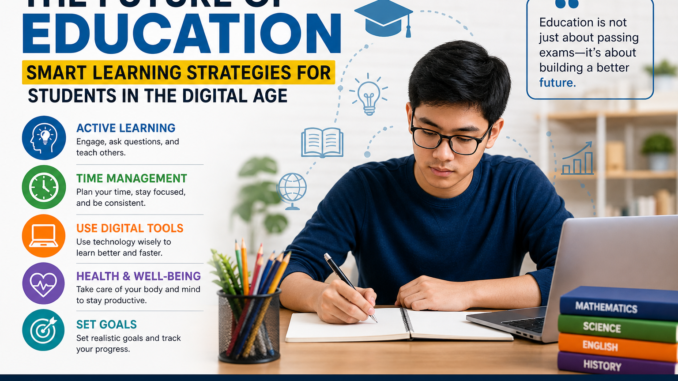
Education is rapidly evolving in the modern world. With the rise of technology, students today have access to more information than ever before. However, having access to information does not automatically guarantee success. What truly matters is how effectively students learn, apply, and retain knowledge. In this article, we will explore smart learning strategies that can help students succeed in the digital age while improving focus, productivity, and long-term understanding.
Understanding Modern Learning Challenges
Today’s students face many distractions. Social media, online entertainment, and constant notifications make it difficult to concentrate. Unlike the past, where learning was mostly limited to classrooms and textbooks, students now need strong self-discipline to stay focused.
Another challenge is information overload. With millions of websites, videos, and articles available online, students often feel overwhelmed. Without proper guidance, they may struggle to identify reliable sources and waste time on unhelpful content.
To overcome these challenges, students must adopt smart learning techniques that improve efficiency and reduce stress.
Active Learning vs Passive Learning
One of the most important strategies is shifting from passive learning to active learning.
Passive learning includes simply reading books or watching videos without engagement. While it may feel productive, it often leads to poor retention.
Active learning, on the other hand, involves:
Taking notes in your own words
Asking questions
Teaching others
Practicing what you learn
Studies show that students who use active learning techniques remember information longer and understand concepts more deeply.
For example, instead of just reading a chapter, try summarizing it or explaining it to a friend. This simple change can significantly improve learning outcomes.
Time Management for Better Productivity
Time management is a critical skill for academic success. Many students fail not because they lack intelligence, but because they misuse their time.
A simple and effective method is the Pomodoro Technique:
Study for 25 minutes
Take a 5-minute break
Repeat the cycle
This method helps maintain focus and prevents burnout. After completing four cycles, take a longer break of 15–30 minutes.
Creating a daily study schedule also helps. Allocate specific time slots for each subject and stick to your plan. Consistency is more important than studying for long hours irregularly.
The Importance of Digital Tools
Technology can be a powerful ally if used correctly. There are many digital tools designed to improve learning efficiency:
Note-taking apps for organizing ideas
Online courses for skill development
Educational videos for visual learning
Flashcard apps for memorization
However, students should avoid using too many tools at once. Choose a few reliable platforms and focus on using them effectively.
Additionally, always verify the credibility of online resources. Not all information on the internet is accurate, so it is important to rely on trusted educational websites.
Building Strong Study Habits
Success in education is largely determined by habits. Good study habits can make learning easier and more enjoyable.
Here are some essential habits:
Study at the same time every day
Keep your study space clean and organized
Set clear goals before each study session
Review what you learned regularly
Consistency builds discipline, and discipline leads to long-term success.
It is also important to avoid multitasking. Studying while checking your phone or watching videos reduces efficiency. Focus on one task at a time for better results.
The Role of Critical Thinking
In today’s world, memorization is not enough. Students must develop critical thinking skills.
Critical thinking involves:
Analyzing information
Evaluating different viewpoints
Solving problems logically
Instead of accepting information blindly, students should ask questions such as:
Is this information reliable?
What evidence supports this idea?
Are there alternative explanations?
These skills are especially important in the digital age, where misinformation is common.
Learning Beyond the Classroom
Education is no longer limited to schools. Students can learn valuable skills outside the classroom through:
Online courses
Educational YouTube channels
E-books and articles
Practical experiences
Self-learning is becoming increasingly important. Students who take initiative and explore new topics independently gain a significant advantage.
For example, learning skills such as communication, digital literacy, and problem-solving can greatly improve future career opportunities.
Maintaining Mental and Physical Health
Academic success is closely linked to health. Without proper physical and mental well-being, it becomes difficult to focus and perform well.
Students should:
Get enough sleep (7–8 hours per night)
Eat healthy food
Exercise regularly
Take breaks when needed
Stress management is also essential. Overloading yourself with study can lead to burnout. Balance is key to maintaining long-term productivity.
Practicing mindfulness or simple relaxation techniques can help reduce stress and improve concentration.
Setting Realistic Goals
Goal setting gives direction and motivation. However, goals must be realistic and achievable.
Instead of saying, “I will study all day,” set specific goals like:
“I will complete two chapters today”
“I will practice 20 math problems”
Breaking large goals into smaller tasks makes them easier to manage and increases the chances of success.
Tracking your progress also helps maintain motivation. Celebrate small achievements to stay encouraged.
Conclusion
The future of education depends on how well students adapt to the changing world. With the right strategies, anyone can improve their learning efficiency and achieve academic success.
By focusing on active learning, managing time effectively, using digital tools wisely, and maintaining good habits, students can overcome challenges and reach their full potential.
Education is not just about passing exams—it is about gaining knowledge, developing skills, and preparing for a better future. In the digital age, smart learning is the key to success.
Leave a Reply