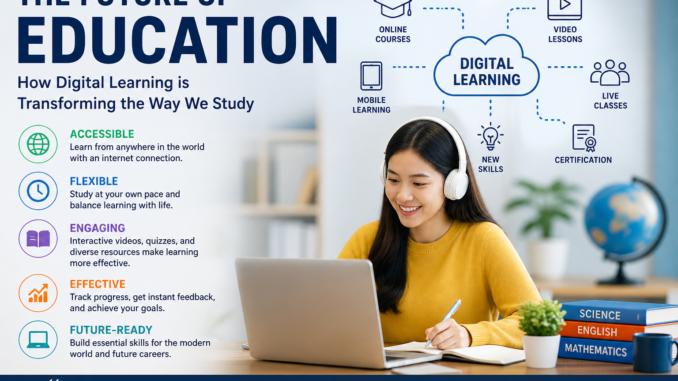
Education has always been a key driver of personal and societal growth. Over the past decade, however, the way people learn has changed dramatically. With the rise of digital technology, traditional classrooms are no longer the only place where learning happens. Today, students can access knowledge anytime, anywhere, thanks to online education platforms, mobile apps, and virtual classrooms. This shift is not just a trend—it is the future of education.
One of the biggest advantages of digital learning is accessibility. In the past, students needed to be physically present in a classroom to receive instruction. This created challenges for people living in rural or remote areas. Now, with just a smartphone and internet connection, anyone can enroll in online courses from top universities around the world. This has opened doors for millions of learners who previously had limited educational opportunities.
Another important benefit is flexibility. Traditional education systems often follow strict schedules that may not suit everyone. Digital learning allows students to study at their own pace. Whether someone is working full-time, managing a family, or pursuing other interests, online education makes it possible to balance learning with daily responsibilities. This flexibility has made education more inclusive and adaptable to modern lifestyles.
In addition, digital learning offers a wide range of resources. Instead of relying solely on textbooks, students can access videos, interactive quizzes, podcasts, and live discussions. These diverse formats make learning more engaging and effective. For example, visual learners can benefit from video tutorials, while others may prefer reading or listening to audio content. This personalized approach helps improve understanding and retention of information.
Technology has also made it easier for teachers to deliver high-quality education. Online tools such as learning management systems (LMS), video conferencing software, and digital assessment platforms allow educators to create interactive lessons and monitor student progress in real time. Teachers can provide instant feedback, track performance, and adjust their teaching methods based on student needs. This improves the overall learning experience.
Moreover, digital education encourages the development of important skills for the modern world. Students not only gain academic knowledge but also learn how to use technology effectively. Skills such as critical thinking, problem-solving, communication, and digital literacy are essential in today’s job market. By engaging with online platforms, students become more independent and self-motivated learners.
Despite its many advantages, digital learning also comes with challenges. One major issue is the digital divide. Not everyone has access to reliable internet or modern devices. This can create inequality in educational opportunities. Governments and organizations must work together to improve infrastructure and ensure that all students can benefit from digital education.
Another challenge is maintaining student engagement. Without face-to-face interaction, some students may feel isolated or lose motivation. To address this, educators need to design interactive and engaging content. Features such as live classes, group discussions, and gamified learning can help keep students interested and involved.
Cybersecurity and data privacy are also important concerns. As students use online platforms, their personal information must be protected. Educational institutions should implement strong security measures and teach students about safe online practices.
Looking ahead, the future of education will likely combine both traditional and digital methods. This approach, known as blended learning, offers the best of both worlds. Students can benefit from in-person interaction while also enjoying the flexibility and resources of online learning. Schools and universities are already adopting this model to enhance the learning experience.
Artificial intelligence (AI) and virtual reality (VR) are expected to play a significant role in shaping the future of education. AI can provide personalized learning experiences by analyzing student performance and recommending tailored content. VR can create immersive environments where students can explore complex subjects in a more interactive way. For example, medical students can practice surgeries in a virtual setting, while history students can explore ancient civilizations.
In conclusion, digital learning is transforming education in powerful ways. It has made education more accessible, flexible, and engaging than ever before. While challenges remain, the benefits far outweigh the drawbacks. As technology continues to evolve, education will become even more innovative and inclusive. For students, teachers, and institutions, embracing digital learning is not just an option—it is a necessity for future success.
Leave a Reply